Chiropractors can read us anywhere, anytime
First Quarter 2026
(Jan-Mar)
Volume 6, Issue 6-3
read with your mind, care with your heart
Freedom, Truth, Health: Our 3 founding principles put to the test
Dateline: Melbourne (20 December 2025)
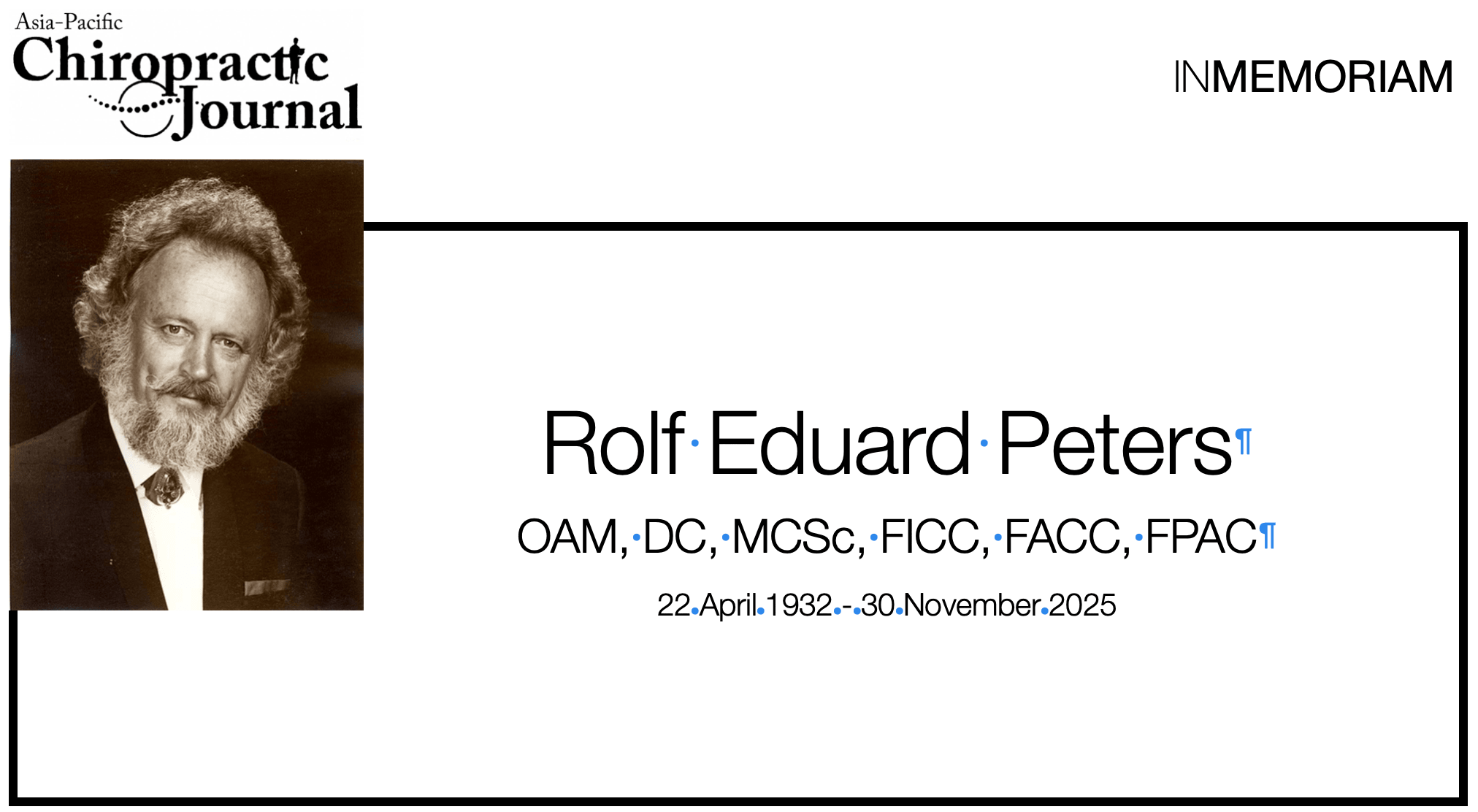
Narrative: Even long-term and highly regarded relationships end, given time. The most poignant right now of course is the passing of our Executive Editor, Dr Rolf E Peters, OAM, whom I memorialise elsewhere. He was special to me.
On a more pragmatic note, this Journal announces the withdrawal by the World Congress of Chiropractic Students (WCCS) from our agreement for this Journal to publish and support them. Our support was through mentoring of their leadership group to achieve publication. There were no limits or boundaries on what could be published, but it seems a recent paper has upset the WFC, a sponsoring body of the WCCS, and the WCCS will no longer submit papers to us.
As is to be expected, this matter is far bigger than any Director of the WCCS can imagine and in this Editorial I explain what the Editorial Committee of this masthead perceive is really happening. It goes to the heart of the philosophical basis of the program in Clinical Biomechanics at the University of Southern Denmark which has long been accredited as graduating Chiropractors.
The matter also goes to the emergence of what is now called the Majority World as opposed to America and Europe which are very much the Minority World and definitely not the future of Chiropractic education.
Indexing Terms: Chiropractic; subluxation; philosophy; education; Majority world; future of Chiropractic.
Cite: Ebrall P. Freedom, Truth, Health: Our 3 founding principles put to the test. Asia-Pac Chiropr J. 2026;6.3. apcj.net/papers-issue-6-3/#EbrallEditorialJan26
Editors note: At the time of publication discussions are underway with the Co-Presidents of the WCCS.
The healing touch: Where ancient wisdom meets modern technology in Chiropractic care
Narrative: Artificial intelligence (AI) is transforming healthcare, offering tools for imaging analysis, decision support, documentation, and practice operations.
Machine learning has achieved strong performance in specific spine imaging tasks and can integrate patient history, imaging, and other clinical variables to support risk stratification and care planning.
I argue that the foundation of Chiropractic care rests not in algorithms, but in the skilled, compassionate touch of human hands and clinical reasoning developed over years of practice.
Our hands are richly endowed with finely discriminating receptors which through layered palpation from superficial to deep structures build us a 3D anatomical map with minimal effective pressure to optimise mechanoreceptor activation. With focused attention and avoidance of unnecessary pain that can induce guarding, we can build a predictive model to guide the intent of our adjustment.
Indexing terms: Chiropractic; AI; palpation; touch; touch receptors; 3D model.
Cite: Bacino O. The healing touch: Where ancient wisdom meets modern technology in Chiropractic care. Asia-Pac Chiropr J. 2026;6.3. www.apcj.net/papers-issue-6-3/#BacinoHealingTouch
When Skepticism Becomes Dogma: A Scientific Rebuttal to Samuel Homola’s ‘Pseudoscience in Chiropractic’
Narrative: Samuel Homola is a retired Chiropractor known for his critical views on certain practices within the profession. He has been active since the 1960s and has authored several books. His schtick is his claim that he is emphasising the importance of evidence-based practices in Chiropractic care.
Here I present sound arguments exposing his flawed reasoning and show he is out of touch with the profession as it is today.
Homola’s claims are illogical and he shows weakness in his understanding of the fundamental tenets of the discipline. I conclude it is not Chiropractic which is weak but Homola himself who has slid from skepticism to dogma.
Indexing terms: Chiropractic; Gonstead; technique; Homola; dogma.
Cite: Fowler DA. When Skepticism Becomes Dogma: A Scientific Rebuttal to Samuel Homola’s ‘Pseudoscience in Chiropractic. Asia-Pac Chiropr J. 2026;6.3. apcj.net/papers-issue-6-3/#FowlerHomolaRebuttal
Sacro Occipital Technique (SOT) Indicators: Accessing Problems and Developing Strategies
Narrative: Here I discuss the complexity of the SOT primary indicators; Heel Tension, Arm/Fossae, and SOTO, but also for how they clearly illustrate the functional connection between the body's structural and neurological systems.
It is important to keep in mind when practicing SOT that the indicators discussed in this paper can at times overlap and vary. Nevertheless, verification (retesting the indicator post adjustment) can confirm the choices you have made.
All three plumb line scenarios on Chart #3 can greatly benefit from the Sitting Disc Technique (SDT) especially if indicated, ‘Clinically the Straight Leg Raise (SLR) could be used as a pre and post assessment tool to judge the effectiveness of the SDT adjustment
Indexing Terms: Sacro Occipital Technique (SOT); Problem-Solving; MB DeJarnette; Primary Cranial Sacral Respiratory Mechanism.
Cite: Getzoff H. Sacro Occipital Technique (SOT) Indicators: Accessing Problems and Developing Strategies. Asia-Pac Chiropr J. 2026;6.3. apcj.net/Papers-Issue-6-3/#GetzoffSOTStrategies
Universal Intelligence in the Philosophy of Chiropractic: A Comparative Analysis
Objective: To examine how six influential chiropractic authors have conceptualised Universal Intelligence in relation to DD Palmer's foundational understanding, with the objective of revealing patterns of continuity and evolution in chiropractic philosophical thought.
Methods: A qualitative, historical-philosophical methodology was employed to conduct systematic comparative analysis of primary works from Palmer (1910), Stephenson (1927), Gold (1998), Coulter (1999), Koch (2008), Strauss (1991), and Senzon (2011). The analytical framework combined historical analysis, conceptual mapping, and philosophical interpretation using established hermeneutical methods and comparative matrix methodology.
Results: Analysis revealed a spectrum of fidelity to Palmer's original vision, with Gold (1998) and Senzon (2011) maintaining strongest alignment through passionate advocacy and sophisticated historical understanding, while Koch (2008) and Strauss (1991) represented greatest departures through philosophical abstraction and theological separation. Four major evolutionary trends emerged: progressive secularisation, academic translation, practical simplification, and theological management of Palmer's original spiritual conceptualisation.
Discussion: The evolution demonstrates what we term ‘The Palmer Paradox’, each author’s legitimate contemporary purposes (academic respectability, practical application, theological clarity) collectively represent a systematic movement away from Palmer's original spiritual, mystical, and evolutionary understanding toward more secularised, academically acceptable, and practically applicable interpretations.
Conclusion: While Universal Intelligence remains central to Chiropractic philosophy, its evolution away from the Founder’s core conceptualisation reflects the profession’s ongoing tension between honouring Palmer’s original spiritual vision and meeting contemporary academic, clinical, and cultural demands. The systematic transformation raises important questions about authenticity, relevance, and the future direction of Chiropractic philosophy.
Indexing terms: Chiropractic; Philosophy; Universal Intelligence; DD Palmer; Stephenson; Gold; Coulter; Koch; Strauss; Senzon.
Cite: Wenban AB, Denis FL. Universal Intelligence in the Philosophy of Chiropractic: A Comparative Analysis. Asia-Pac Chiropr J. 2026;6.3. www.apcj.net/papers-issue-6-3/#WenbanDenisUI
Vertebral Subluxation as an Emergent Energy-Conserving Phenotype: An integrative framework of Constructal Law, Free Energy Principle, Dynamical Systems Theory, and Evolutionary Biology
Objective: To reconceptualise vertebral subluxation not as a static lesion or outdated metaphysical construct, but as an emergent, energy-conserving state within living systems. This paper develops a novel theoretical framework by integrating the Constructal Law, the Free Energy Principle, Dynamical Systems Theory, and evolutionary biology, thereby positioning vertebral subluxation as a predictable adaptive phenomenon rather than a pathological anomaly.
Methods: A critical theoretical integration approach was employed. Four scientific frameworks were systematically mapped, aligned through shared principles of flow optimisation, prediction error minimisation, attractor stabilisation, and energy conservation, and synthesised into a unifying model. Mathematical formulations were used to articulate precision in the proposed dynamics, including cost functions for prediction error, attractor basin models, and energy minimisation equations.
Results: The integrated model yields the following insights:
Constructal Law: Subluxation emerges as a bottleneck in systemic flow that paradoxically optimises energy distribution under constraints. (1, 2)
Free Energy Principle: Subluxation represents fixation of prediction error when the energetic cost of correction exceeds the stability gained by maintaining the error. (3 - 6)
Dynamical Systems Theory: Subluxation functions as a stable attractor state in the organism’s energy landscape; chiropractic adjustments act as perturbations capable of shifting the system into more adaptive basins. (7 - 9)
Evolutionary Biology: Subluxation is interpreted as a phenotype of energy conservation, trading long-term adaptability for short-term metabolic efficiency. (10 - 13)
Mathematically, subluxation corresponds to a local minimum of total energetic cost across flow, prediction, and stability domains. Chiropractic adjustment is modelled as a perturbation that must exceed the depth of this attractor basin to restore systemic flexibility.
Discussion: This reframing addresses long-standing criticisms of subluxation as vague, unscientific, or obsolete. By situating subluxation within universal scientific principles, it demonstrates conceptual clarity, biological plausibility, and testability. Anticipated counterarguments (e.g., lack of empirical evidence, reliance on metaphors, evolutionary rationalisation) are rebutted by emphasising the generative potential of the model for hypothesis-driven research, including neuroimaging, metabolic cost analysis, and nonlinear attractor mapping.
Conclusion: Vertebral subluxation is best understood as an emergent, energy-conserving attractor state reflecting the organism’s adaptive trade-offs in prediction, flow, and stability. Chiropractic adjustment is correspondingly redefined as a targeted perturbation within this energy landscape, designed to restore adaptive flexibility and optimise systemic function. This theoretical synthesis provides Chiropractic with a scientifically rigorous foundation for its central concept and establishes a research agenda linking Chiropractic care to cutting-edge theories in physics, neuroscience, and evolutionary biology.
Indexing terms: Chiropractic; vertebral subluxation; constructal law; free-energy principle; predictive coding; dynamical systems theory; evolutionary biology.
Cite: Shiga T. Vertebral Subluxation as an Emergent Energy-Conserving Phenotype: An integrative framework of Constructal Law, Free Energy Principle, Dynamical Systems Theory, and Evolutionary Biology. Asia-Pac Chiropr J. 2026;6.3. www.apcj.net/papers-issue-6-3/#ShigaEnergyConservingPhenotype
The Chiropractic adjustment as the treatment of choice for Chiropractors
Narrative: The idea of subluxation has strong clinical relevance within the practice of Chiropractic, being integral to some 80% of the profession globally and is overt in more than 1,600 peer-reviewed, indexed Case Reports.
History records the founder of the discipline, DD Palmer, as naming the unique psychomotor skills that he developed to, as he said ‘move the vertebrae of the spinal column’, the ‘adjustment’. These skills were taught by him at the Palmer School of Chiropractic and are now used by nearly all Chiropractors globally. The skills required to safely deliver the adjustment are a mandatory attainment in every curriculum. The purpose is to restore health and well-being.
A variety of techniques can be applied to correct subluxation and when these meet certain criteria, given here, for applied force and speed of force application, then the therapeutic intervention is known as a Chiropractic adjustment.
To conclude, I present Haavik et al’s contemporary model of the mechanism by which central segmental motor control (CSMC) problems and spinal adjustments result in neuroplastic consequences that impact neuromuscular function.
Indexing Terms: chiropractic; subluxation; adjustment; manipulation’; central segmental motor control (CSMC).
Cite: Ebrall PS. The Chiropractic adjustment as the treatment of choice for Chiropractors. Asia-Pac Chiropr J. 2026;6.3 apcj.net/papers-issue-6-3/#EbrallAdjustment
Saccades as central neurological biomarkers of Chiropractic adjustments: A research narrative on joint afferentation and brain-based outcomes
Narrative: The spine is not simply a stack of bones, it is an antenna for the nervous system. Saccades transform intention into motion faster than conscious awareness can follow. They are influenced by every major region that processes sensory input and coordinates movement. This makes them powerful tools for detecting central changes triggered by chiropractic adjustments.
When a spinal segment is realigned and joint afferentation improves, the nervous system samples the world differently. Eye movements reveal this change in real time. When Chiropractic clinicians examine saccades, they are not diagnosing eye disease; they are observing the nervous system solving a motor problem at high speed.
Indexing terms: Chiropractic; adjustment; saccades; autonomic regulation; joint afferentation; brain-based outcomes.
Cite: Traster D. Saccades as central neurological biomarkers of Chiropractic adjustments: A research narrative on joint afferentation and brain-based outcomes. Asia-Pac Chiropr J. 2026;6.3. www.apcj.net/papers-issue-6-3/#TrasterSaccades
Hypothesis: Cranial Suture Complexity is Influenced by Sensory Innervation
Narrative: Recognition of the significance of the mobility implied by cranial sutural patency is one of the underpinnings of Chiropractic and osteopathic clinical techniques for the cranium.
Given the influence of respiratory muscles on sutural complexity, certain breathing exercises may be found to promote sutural complexity. More generally, any interventions to optimise breathing such as respiratory therapy, Chiropractic adjustments, and osteopathic manipulation could be advantageous in this regard.
I describe factors affecting the development of cranial sutures and propose the hypothesis ‘Cranial suture complexity is influenced by sensory innervation’ and suggest ways in which this can be clinically examined.
Indexing terms: Chiropractic; cranial sutures; comparative anatomy; breathing therapies; cranial treatment.
Cite: Masarsky CS. The Wide-Angle Lens. Hypothesis: Cranial Suture Complexity is influenced by Sensory Innervation. Asia-Pac Chiropr J. 2026;6.3. www.apcj.net/papers-issue-6-3/#MasarskySutureComplexity
Carpal Tunnel Syndrome: Conservative Care
Narrative: A contributory factor in Carpal Tunnel Syndrome (CTS) is overuse of the wrist with repetitive grasping, possibly shortening the flexor muscles and related connective tissue. This shortening may reduce the size of the tunnel or modify the passageway and compromise the median nerve’s pathway creating entrapment and irritation.
Since the main use of our hands involve grasping, touching, and holding it is common to overuse our wrist flexor compartment possibly creating a chronic flexed wrist joint.
I describe a method of assessing and conservatively treating this type of CTS (flexion overuse), which incorporates chiropractic extremity adjusting, using KT ProX tape, and rehabilitative exercises.
Indexing terms: Chiropractic; SOT; carpal tunnel syndrome; wrist rehabilitation.
Cite: Blum CL. Carpal Tunnel Syndrome: Conservative Care. Asia-Pac Chiropr J. 2026;6.3 apcj.net/Papers-Issue-6-3/#BlumCarpalTunnel
Chiropractic school without a student clinic: Reflections from a student
Narrative: Institutions offering a program of Chiropractic education are required to attain and hold programmatic accreditation by an agency approved for this purpose in the jurisdiction of the institution.
It is reasonable for the profession to expect that graduates have attained clinical capability with entry-level competency in the unique psychomotor skills of the discipline, namely spinal adjusting, as the highest order manipulative skill.
In this reflection I question from first-hand experience whether this expectation meets reality at the University of Southern Denmark.
Indexing terms: Chiropractic; World Congress of Chiropractic Students, WCCS; clinical training; professional identity; student perspective.
Cite: Author name withheld. Chiropractic school without a student clinic: Reflections from a student. Asia-Pac Chiropr J. 2025;6.2. www.apcj.net/papers-issue-6-2/#SchoolWithoutClinic
Editor’s note: Our correspondent raises serious issues which the profession must promptly address in full.

Battles of a Chiropractic student
Narrative: Higher education can be a battle, and being a chiropractic student brings many.
Here I share my thoughts on the difficulties of students and new graduates finding their own identity within the chiropractic community due to the ever-growing health politics.
Indexing terms: Chiropractic; World Congress of Chiropractic Students, WCCS; Leadership; new graduate; student perspective.
Cite: Author withheld. Battles of a Chiropractic student. [WCCS]. Asia-Pac Chiropr J. 2024;4.3 URL apcj.net/papers-issue-4-3/#BattlesofaStudent
Case Reports

Dry nights via Chiropractic care and/or Spinal Galant reflex integration:
A case study series of 6 school children with Nocturnal Enuresis
Narrative: This case study report discusses 6 cases of bedwetting children who received Chiropractic care and or functional neurology therapy based on the Melillo Method™. These children are aged between 6 and 15. All cases had never had one dry night since birth and one common finding shared across these cases was that they all had the Spinal Galant reflex retained when presented in their initial clinical consultations. The Spinal Galant reflex is present at birth that helps to facilitate trunk movements as the neonate descends through the birth canal. (3) The reflex should be inhibited by higher cortical functions and disappear by 9 months of age. The Spinal Galant reflex is tested by stroking the skin along the side of the spine, if present, that would cause muscle contraction and lateral flexion of the trunk toward the side stimulated. (19)
The common causes of nocturnal enuresis in children include developmental delay, constipation, poor arousal sleep, small bladder capacity, and neural integrity of both micturition centre of brainstem and lumbosacral plexus. Conservative options for early intervention include pelvic floor exercise or bladder training, rewards for dry nights, and moisture alarm devices. For medical treatment, the first line medications for nocturnal enuresis are desmopressin, anticholinergics and tricyclic antidepressants.
The improvements of bedwetting behaviour in these 6 cases with Chiropractic and or Spinal Galant reflex integration provided the practitioners, parents, and children themselves with a novel direction to approach bedwetting. Chiropractic care was aiming to offer optimal neural integrity by removal of vertebral subluxations and nerve interference to promote bladder control. NeuroImpulse Protocol™ is the chiropractic technique employed for 4 of the cases in this case study series.
Melillo Method™ is a functional neurology approach based on brain stimulations that promote neuroplasticity to improve cerebral network and functions. It is commonly offered to children with neurodevelopmental delay. There is a strong emphasis on primitive reflex integrations. (16) There were 2 cases with severe neurodevelopmental conditions exhibiting nocturnal enuresis that received Melillo Method™ in this case study series.
Cases 1 & 2 received Chiropractic adjustments only; Cases 3 & 4 received Melillo Method™ functional neurology therapy involving brain stimulation modalities with an emphasis of primitive reflex integration that included Spinal Galant reflex but no Chiropractic adjustment; Cases 5 & 6 received Chiropractic adjustments and were given Spinal Galant integration home exercise.
Indexing Terms: Chiropractic; AK; Melillo Method; Spinal Galant reflex; nocturnal enuresis; NeuroImpulse Protocol.
Cite: Huang JS-F. Dry nights via chiropractic care and or Spinal Galant reflex integration:A case series of 6 school children with Nocturnal Enuresis. Asia-Pac Chiropr J. 2026;6.3. www.apcj.net/papers-issue-6-3/#HuangEneuresisx6
Two case reports, M46 & M58yo, of long-term stroke recovery using a sensory motor reintegration approach
Background: Stroke-related motor and balance deficits often persist for years, yet evidence shows neuroplasticity can be rekindled long after the acute phase2,6. We present two chronic stroke cases treated with an integrated programme of manual spinal adjustments, vestibulo-ocular reflex (VOR) exercises, multi-axis whole-body rotation, reaction-time drills, quantitative EEG (QEEG) tracking, and autonomic monitoring (Ocula) delivered in a regional clinic.
Case summaries: M58, 36‑months post‑ischaemic stroke with gait and cognitive deficits; M46, 8‑years post‑cerebellar infarct with imbalance and daily headache. With multiple sessions over several months, both showed improved posturography, oculomotor metrics, reaction time, and functional independence.
Interventions for both patients: (i) high-velocity low-amplitude spinal adjustments to segments with fixations; (ii) daily home VOR × 2 and dual-task balance drills; (iii) progressive multi-axis chair rotations (yaw, pitch, roll; 30–60 deg s⁻¹; 20–60 s bouts) with concurrent cognitive tasks; (iv) reaction-time panels (overlap, gap, anti- saccade paradigms); (v) lifestyle coaching and paced aerobic activity. QEEG and smartphone pupillometry (Ocula™) guided the session intensity.
Outcomes: Both survivors demonstrated objective sensory-motor and cognitive gains well beyond the accepted twelve-month plateau.
Conclusion: These cases illustrate that chronic stroke deficits can improve when a sensory-rich, individualised, and autonomically titrated programme is applied. Multi-axis vestibular stimulation and spinal adjustments may act as potent afferent primers that amplify subsequent task-specific learning. Controlled studies are required, but clinicians should consider multimodal, data-informed approaches rather than accepting late-phase stasis. Of note is that long term treatment appears to deliver long term gains.
Indexing Terms: Functional Neurological Disorder; Chiropractic; adjustment; chronic stroke recovery; sensory motor integration; multi axis vestibular stimulation; qEEG; Pupillometry.
Cite: Richardson D. Two case reports, M46 & M58yo, of long-term stroke recovery using a sensory motor reintegration approach. Asia-Pac Chiropr J. 2026;6.3. www.apcj.net/papers-issue-6-3/#RichardsonStrokeRecovery
Structural and biochemical interactions within the Chiropractic patient: An Adrenal Stress Disorder (ASD) case report
Narrative: Adrenal stress disorders (ASD) are one of the most common conditions globally, and stress-related illnesses are one of the most common comorbid conditions seen in Chiropractic patients and faced by integrative Chiropractic practitioners.
Every Chiropractor will discuss stress with a large number of their patients simply because most sick people, especially if they’ve been sick for any length of time, are involved with stress as a complicating factor of their health problems. In some cases, ‘finding and fixing’ this primary human problem unravels an immense complexity of other Chiropractic-relevant troubles in our patients.
Chiropractic applied kinesiology manual muscle testing procedures can be a helpful screening tool for patients with ASD. This case report discusses the story of a patient whose positive outcomes improved dramatically once ASD was recognised and treated, in addition to all the physical corrections made by the chiropractor. His complicated joint dysfunctions became very minor in his life after nearly a decade of pain.
Indexing Terms: Chiropractic; AK; Applied Kinesiology; Adrenal stress disorders; stress.
Cite: Cuthbert S. Structural and biochemical interactions within the Chiropractic patient: An Adrenal Stress Disorder (ASD) case report. Asia-Pac Chiropr J. 2026;6.3. www.apcj.net/papers-issue-6-3/#CuthbertAdrenalStress
Aberrant proprioception from dental crowns as a cause of unexplained Functional Muscle Weakness: A Case Series
Background: Unexplained, non-structural muscle weakness often presents a significant diagnostic and therapeutic challenge, frequently leaving patients undiagnosed or with long-term functional impairment. While central or neurological origins are often investigated, the role of altered peripheral proprioceptive input is often overlooked.
Case Presentation: We present three cases of patients suffering from severe chronic pain and functional muscle weakness. In all cases, the muscle weakness could be instantly and reversibly resolved by applying gentle pressure to the biting surface of specific dental crowns. Following the removal of the implicated crown(s), all patients achieved a full and lasting recovery from both the weakness and their concomitant chronic pain.
Discussion: This report proposes a mechanism where aberrant proprioceptive input from metallic dental crowns alters resting muscle tone via the trigeminal and wider nervous system pathways. This clinical observation supports research demonstrating that sensory input from teeth can rapidly modulate muscle excitation and inhibition. These cases suggest that dental restoration materials may be a previously unrecognised cause of functional muscle weakness and chronic musculoskeletal pain.
Indexing Terms: Chiropractic; AK; Applied Kinesiology; proprioceptive medicine; afferentology; dental crowns.
Cite: King S. Aberrant proprioception from dental crowns as a cause of unexplained Functional Muscle Weakness: A Case Series. Asia-Pac Chiropr J. 2026;6.3. www.apcj.net/papers-issue-6-3/#KingDentalCrowns
Improvement in thoracic alignment and bone density in a 65-year-old female with six compression fractures and severe osteoporosis following two weeks of concentrated Chiropractic care: A case report
Background: A 65-year-old female with a complex medical and personal history presented for Chiropractic care with primary concerns relating to overall wellbeing, and whose initial testing revealed severe osteoporosis.
Intervention: The patient commenced concentrated Chiropractic care using the Averio Functional Neurological technique which deploys a high-number of low force adjustments over the course of five days inpatient care.
Outcomes: Following two separate weeks of concentrated care, the patient reported improvements in sleep quality, energy levels, mood stability, and daily functional capacity. Repeat testing also revealed significant improvements in bone density.
Conclusion: This case demonstrates a role for Chiropractic care in supporting improvements in bone density and remodelling.
Indexing Terms: Chiropractic; subluxation; concentrated care; osteoporosis; scoliosis; well-being.
Cite: Kotlerman S, Martin A, Clark J, Dhaliwal A, Postlethwaite R, McIvor C. Improvement in thoracic alignment and bone density in a 65-year-old female with six compression fractures and severe osteoporosis following two weeks of concentrated chiropractic care: A case report. Asia-Pac Chiropr J. 2026;6.3. www.apcj.net/Papers-Issue-6-3/#KotlermanOsteoporosis

Decrease in pain, and increase in athletic performance and recovery time 44-year-old male: A case report
Background: A 44-year-old male presented for chiropractic care with primary complaints of back and neck pain that had been intermittent over the course of the past twenty years. Though his initial complaints were not novel, his outcomes beyond pain alone were notable.
Intervention: The patient was checked and adjusted using the Advanced Biostructural Correction Technique.
Outcomes: After a twelve-week course of care, the patients abnormal clinical findings had reduced from 23/45 to 5/45 alongside a significant improvement in posture, and a decrease in pain. A novel finding was that the patient also reported marked increase in athletic performance and recovery time.
Conclusion: Chiropractic care belongs in the conversation around human performance and recovery, not just in the world of neck and back pain.
Indexing Terms: Chiropractic; Subluxation; Advanced Biostructural Correction Technique; ABC; athletic performance; well-being.
Cite: Hartmann R, Postlethwaite R, McIvor C. Decrease in pain, and increase in athletic performance and recovery time 44-year-old male: A case report. Asia-Pac Chiropr J. 2026;6.3. www.apcj.net/papers-issue-6-3/#HartmannAthleticPerformance

Improvement in ADHD symptoms and mental ease in a 30-year-old female with multiple physical trauma: A case report
Background: A 30-year-old female presented for Chiropractic care with primary complaints of back and neck pain, and paraesthesia. She was a Hashimoto’s sufferer with a history of multiple traumas.
Intervention: The patient commenced a course of Chiropractic care during which she was checked and adjusted according to the Advanced Biostructural Correction technique.
Outcomes: In addition to a significant reduction in her presenting complaints, and improvements in her objective findings, the patient reported concomitant improvements in ADHD symptoms and mental ease.
Conclusion: Further research into the impact of Chiropractic care on mental health, including symptoms of adult ADHD may further establish Chiropractic care as a valuable, drug-free treatment option for such patients.
Indexing Terms: Chiropractic; Subluxation; Advanced Biostructural Correction Technique; ABC; ADHD; Hashimoto’s Disease; paraesthesia; well-being.
Cite: Walker H, Postlethwaite R, McIvor C. Improvement in ADHD symptoms and mental ease in a 30-year-old female with multiple physical trauma: A case report. Asia-Pac Chiropr J. 2026;6.3. www.apcj.net/papers-issue-6-3/#WalkerMultipleTrauma


You can contribute to the ASRF Research Project

Disclaimer
This journal is a professional journal by chiropractors for chiropractors. Readers not fully trained as a chiropractor should not act on their own on any information published in these pages and should always discuss their situation with their chiropractor.
The name 'Asia-Pacific Chiropractic Journal' is a registered business name with ASIC, the Australian Securities and Investment Commission.
Fee-free publication
This Journal's fee-per-article is $0.00. You get prompt peer review, open access which means free to all readers, indexation, and EBSCO listing giving full-text to all universities in the world, at no cost to you. Authors retain their IP and reading is free for all. You can download whatever you wish.